
The most important questions to ask a tree service before hiring one are simple: Can you show me proof of insurance? Will you give me a written estimate that describes the exact work? What equipment will you use, and is cleanup included? A professional company answers these questions directly, in writing, before any work begins. A company that dodges them is telling you something important about how it operates.
Tree work is hazardous: heavy wood comes down from height, often over roofs, fences, and lines. These questions protect your property and your wallet, and they take five minutes to ask.
Ask to see a current certificate of liability insurance, and ask whether the company carries workers’ compensation coverage for its crew. Do not accept a verbal “yes, we’re covered.” A legitimate company can email or show the certificate, and you can call the insurer listed on it to confirm it is active. If a worker is injured on your property or a limb damages a neighbor’s fence, paperwork is what decides who pays. Any company that cannot produce proof should not be on your property with a chainsaw.
Requirements vary by the type of work and where the tree stands. Ask what applies to your job and who is responsible for obtaining it. Work on trees near streets or public rights-of-way can involve city rules, which we explain in our guide to tree removal permits in Evansville, Indiana. A prepared company knows these rules before you have to ask twice.
A written estimate should name each tree, describe the work on each one, and state what happens to the wood, brush, and stump. If the estimate is a single line with a total and nothing else, ask for the breakdown before you agree.
Ask whether the crew that shows up works for the company you hired or is a subcontracted crew you have never met. Ask who supervises the job on site and how you can reach that person during the work.
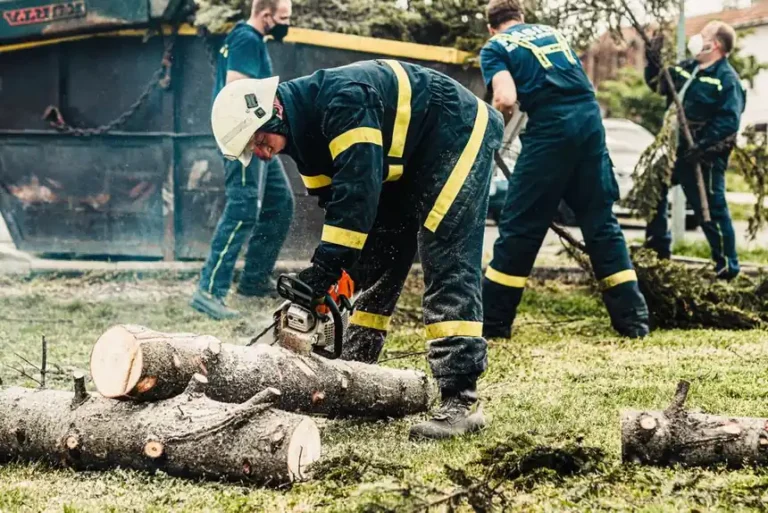
A professional crew explains its plan: where the truck and chipper will sit, how sections will be lowered if the tree hangs over a roof, and how the lawn and driveway will be protected. You can see the range of work this applies to on our tree services page, from removals over structures to routine trimming.
Trees near power lines, roofs, or fences need a specific rigging and cutting plan. Ask the estimator to walk the site with you and describe the approach for your tree, not a generic answer.
Cleanup terms differ widely. Some quotes include chipping brush and hauling logs; others leave everything where it falls. Ask about the stump, surface roots, sawdust in planting beds, and ruts in soft ground.
Stump work is often a separate line item. Ask whether grinding is included, how deep the grinder will go, and what happens to the grindings.
Know the expected duration, the start time, and how the company communicates a weather delay. Evansville storms and saturated ground can move a job; a professional company explains that upfront.
Decay inside a trunk, a hidden cavity, or roots tangled with a sidewalk can change a job. Ask how the company handles surprises: Do they stop and discuss before doing extra work? The only acceptable answer is yes.
References should be recent and, ideally, from your part of the Evansville area. A company with steady local work can answer this easily. Treat references as one part of your decision, alongside insurance proof and the written estimate, not as decoration.
Ask about moving vehicles, unlocking gates, keeping pets inside, and marking sprinkler heads or buried lines you know about. Good preparation questions signal a crew that has thought about your property before the first cut.
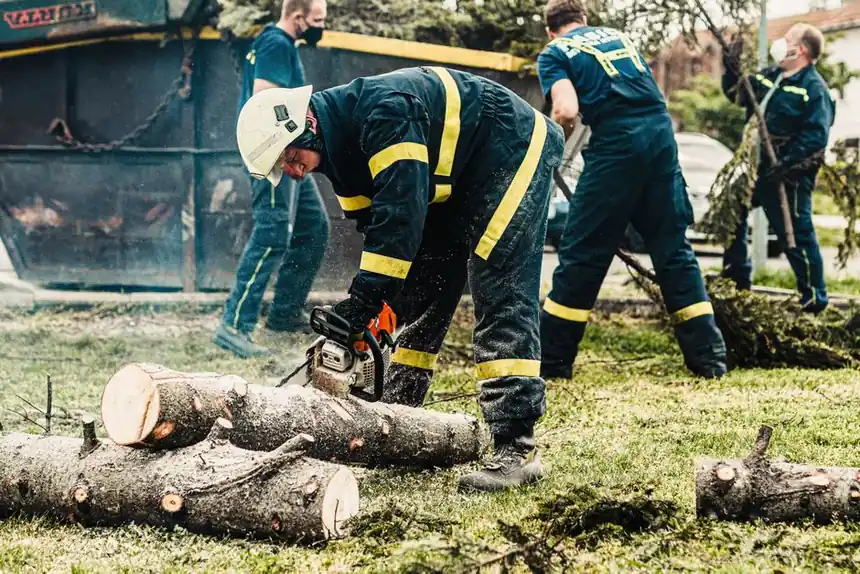
Tree work combines height, heavy wood, and cutting tools, so the risk of injury or property damage is higher than with most home services. If an uninsured worker is hurt on your property, or an uninsured crew damages a neighbor’s home, you can be pulled into costs that should never have been yours. A current certificate, verified with the insurer, confirms that coverage exists before anyone climbs. It is the single most important document to request.
Not usually. Getting two or three written estimates on the same defined scope lets you see which companies inspect carefully, explain their plan, and put details in writing. Our companion guide on how to compare tree service estimates walks through reading those documents side by side. The one exception is an active hazard, such as a split trunk resting on a roof, where making the property safe comes before comparison shopping.
Yes. Asking for complete payment before any work begins, especially in cash, is a well-known warning sign, and it becomes louder after storms, when out-of-town crews move through neighborhoods quickly. A written agreement with payment due on completion of the described work is the normal, safer arrangement. If a company pressures you to decide on the spot, that pressure itself is useful information about how it does business.
At minimum: the trees involved, the exact work on each tree, what happens to wood, brush, and the stump, the cleanup standard, the total for that defined scope, and how changes get approved. Contact details for the on-site supervisor belong there too. If it is not written, it is a memory, and memories differ once money is involved. Five minutes of paperwork before the job prevents nearly every dispute after it.
You do not need to be a tree expert to hire well. You need direct questions, proof instead of promises, and everything important in writing. If you are planning work on your property, start with a conversation: call (844) 542-2293 to describe your trees, ask these questions, and request a written estimate for the exact scope before you decide.