If your Indiana ash tree is thinning from the top down, shedding bark in vertical splits, and sprouting clusters of shoots from its trunk, emerald ash borer is the most likely cause. This invasive beetle has killed tens of millions of ash trees across the Midwest, and Indiana is no exception. The good news is that the infestation follows a recognizable pattern. The hard news is that timing matters: a lightly infested tree is a very different decision from a tree that has lost half its canopy.
Emerald ash borer (EAB) larvae feed in the layer just beneath the bark, carving winding galleries that cut off the tree’s ability to move water and nutrients. The tree starves from the inside while looking almost normal on the outside — which is why the first visible signs usually appear in the upper canopy, far from the ground.
The earliest, most common sign is dieback starting at the top and outer edges of the crown. Leaves get smaller and sparser, whole upper branches go bare, and the canopy thins enough to see through. Homeowners often first notice it as extra sunlight on the lawn where leaves used to be.
Adult beetles chew their way out of the tree through tiny holes shaped like a capital D, about an eighth of an inch wide. Look for them on the trunk and larger limbs, often at eye level and above. They are small and easy to miss, but they are one of the most specific signs of EAB — few other borers leave that exact shape.
As larvae feed underneath, the bark above their galleries often splits lengthwise. Peeling back a split section may reveal the S-shaped, serpentine tunnels packed with fine sawdust-like material that EAB larvae leave behind. Woodpeckers know this too: heavy woodpecker feeding that flakes bark off an ash tree — sometimes called blonding — is a strong indirect sign.
A stressed ash pushes out clusters of leafy shoots from the trunk and the bases of large limbs, trying to replace the canopy it is losing. A trunk suddenly sprouting green tufts is a distress signal, not a recovery.
Walk around your ash tree and check honestly:
The more boxes you check, the more likely the tree is infested — and the longer it probably has been.
This decision deserves straight talk, because both paths are legitimate and the right one depends on the tree’s condition.
Treatment with trunk-injected insecticide can protect an ash tree, and extension guidance generally supports it for healthy, high-value trees that are caught early — typically trees that have lost no more than about a third of their canopy and still have sound structure. Treatment is not a one-time event; it is a repeating commitment every couple of years for as long as you want to keep the tree. Whether a specific tree is a good candidate is something a tree professional can assess in person by judging canopy condition, trunk soundness, and how far the infestation has progressed. No honest assessment can be made from a photo or a description alone.
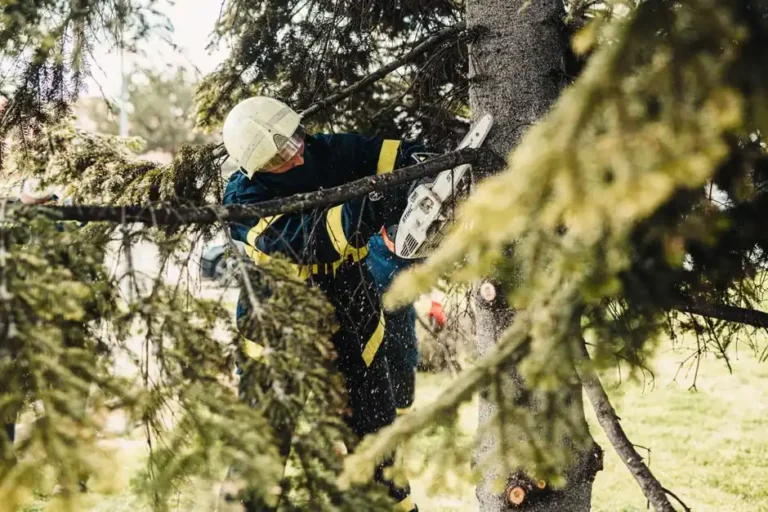
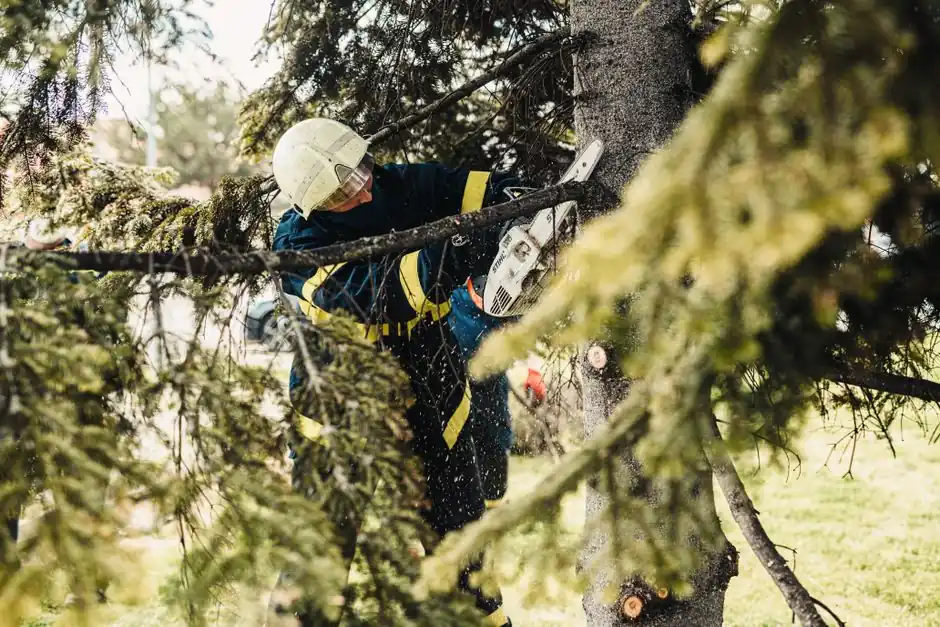
Removal is usually the better answer when the canopy is half gone or worse, when the trunk shows extensive splitting, or when the tree stands over a house, driveway, or sidewalk. Dead and dying ash become brittle quickly — ash wood dries out and loses strength faster than many species once the tree dies — which makes delayed removal both more dangerous and harder to do safely. Planning tree removal in Evansville while the tree is still structurally sound is the safer, calmer version of the same decision.
What rarely makes sense is the middle path of doing nothing with a declining ash over a target. The tree will not recover on its own; EAB does not leave once it arrives.
If you have an ash you want to keep, the time to decide is before symptoms appear, not after. Preventive treatment is most reliable on uninfested or barely infested trees. It is also worth confirming the tree is actually an ash — ash have opposite branching, compound leaves, and distinctive diamond-patterned bark on mature trunks. Our guide to the signs your tree is diseased explains how borer decline fits into the wider pattern of symptoms worth acting on.
How fast does emerald ash borer kill an ash tree? From first infestation to death typically takes two to four years, though the tree often looks fine for the first year or two while larvae multiply under the bark. Once canopy dieback becomes obvious, decline speeds up, because the feeding damage is already extensive. This lag is exactly why annual checks matter: by the time an ash looks sick from the street, the infestation is usually well established.
Can I treat an ash tree myself with a store-bought product? Soil drenches and sprays sold to homeowners exist, but extension guidance notes they work best on smaller trees and deliver inconsistent results on large ones, because getting the product distributed through a big canopy is difficult. Trunk injection, the method most often recommended for large shade trees, requires specialized equipment. For a mature ash you genuinely want to save, having a tree professional assess and treat it is the more reliable route.
Is a dead ash tree dangerous to leave standing? Yes, more so than many other dead trees. Ash wood becomes brittle quickly after death, and dead ash trees are known for dropping limbs and failing unpredictably, sometimes within a year or two of dying. A dead ash near a house, street, or play area should be treated as a removal priority rather than a wait-and-see project. Climbers also cannot safely work some badly deteriorated ash, so waiting can limit your options.
Should I plant another ash tree? No. Planting new ash in Indiana invites the same outcome, because EAB populations persist in the area even after most mature ash are gone. If you are replacing a lost ash, choose a different species suited to your soil and space — a diversity of species across your yard is the best insurance against the next pest arriving and taking everything at once.
How can I tell an ash tree from other shade trees? Three features together are reliable: branches and buds grow opposite each other rather than alternating, the leaves are compound with five to eleven leaflets, and mature bark develops a tight pattern of interlacing ridges that form diamond shapes. Seed clusters hanging in bunches are another clue in late summer and fall. If you are unsure, a professional can identify the tree during an assessment visit.
The treatment decision turns on canopy condition and timing, and both are judged best standing under the tree. Call (844) 542-2293 to request service. A tree professional can assess how far an infestation has progressed, tell you honestly whether treatment is a realistic option, and explain what removal would involve if the tree is too far gone.