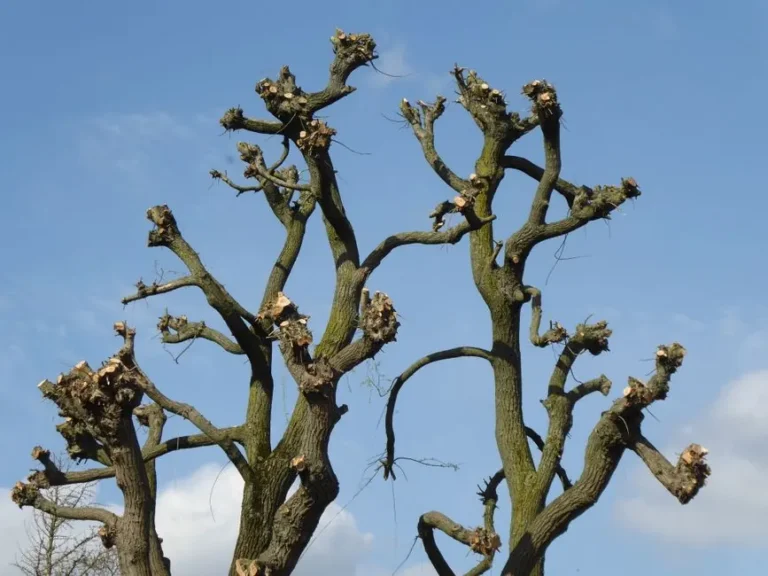
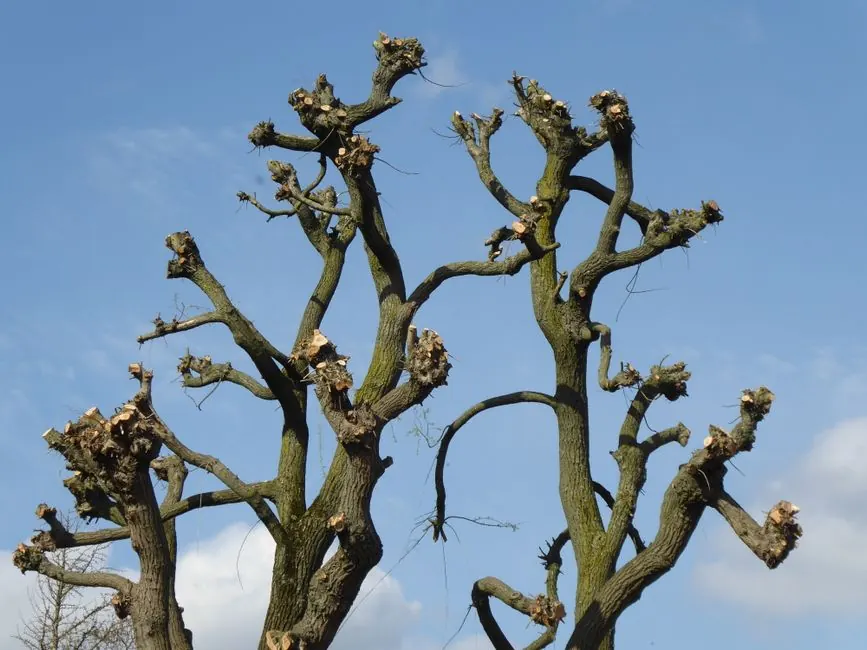
Topping — cutting a tree’s main branches back to stubs to make it shorter — is one of the most harmful things that can be done to a shade tree. It does not control size for long. Instead it starves the tree, opens large wounds that invite decay, and triggers a flush of weak, fast regrowth that is more dangerous than the original branches. There are better ways to reduce a tree.
Topping is sometimes sold under friendlier names: heading, dehorning, hat-racking, rounding over. Whatever the label, cutting large limbs back to stubs, with no suitable lateral to grow on, is the same practice.
Leaves are a tree’s food factory. Topping can remove half or more of the leaf surface in an afternoon, while the root system below is still sized for the full canopy. The tree survives by spending stored reserves on rapid new growth. A mature tree with limited reserves, or one already stressed by drought, disease, or age, may never fully recover that energy. Repeated topping every few years drains the account further each time.
The shoots that explode from below a topping cut are not like normal branches. A normal branch develops inside a socket of overlapping wood as it grows with the trunk. Regrowth shoots attach mostly to the outer surface of the stub, on wood that is often already decaying. They grow astonishingly fast and become heavy, upright, crowded poles — with a connection that weakens as they gain size. A decade later, the tree carries a crown of large, poorly attached limbs: exactly the failure risk the topping was meant to prevent.
A proper pruning cut is made where the tree can defend and seal it. Topping cuts are made in the middle of large limbs, far from any branch collar, often on wood several inches across. Many species cannot seal wounds that large. Decay fungi enter, and the stub rots inward while new shoots grow outward from its surface — until a heavy limb is anchored to a hollow, rotting stub. This is why topped trees feature so often in storm-damage calls around Evansville: wind finds the weakness built in years earlier. The principles behind proper cuts are set out on our tree pruning page.
Only briefly, and at a worse trade each cycle. Because the roots still support a full-sized tree, regrowth after topping is far faster than normal growth — the canopy commonly returns to its original height within a few years, now denser and weaker. Owners then face the same “too tall” problem again, with a tree that is harder and riskier to work on. Compare that with proper tree trimming in Evansville, where selective cuts slow regrowth instead of provoking it.
A topped tree is also widely considered disfigured, and a mature shade tree is part of a home’s character. Once topped, its natural form never fully returns.
When a tree genuinely must be smaller — clearance from a house, a view, a limb growing into a structure — the correct method is crown reduction. A tall limb is shortened by cutting back to a lateral branch at least one-third the diameter of the piece removed. That lateral takes over as the new tip, so the cut can seal, growth stays measured, and the attachment is sound wood rather than a sprout on a stub.
Reduction removes less at once, respects structure, and sometimes must be staged over more than one season on a large tree. It also has limits: reduce too far and it becomes topping by another name — a good crew will tell you where that line is.
Often the real complaint is not height at all. It is shade too dense for the lawn, branches over the roof, or a canopy that feels heavy and dark. Selective thinning — removing a measured share of interior branches — lets light and air through without changing the tree’s height much. Clearance pruning lifts or shortens only the branches causing the problem. Both solve the actual complaint while leaving structure intact, within the standard range of tree services in Evansville.
Occasionally a tree was simply planted in the wrong place: a species that wants sixty feet of room, growing under lines or against a house. No cutting method makes a large species small forever. In that case, knowing when to call an arborist for an honest assessment — and considering removal and replanting with a right-sized species — is better than a decade of damaging cuts. It ends the cycle.
| If you hear this… | What it usually means | Better request | |—|—|—| | “We’ll top it so it stays small” | Stubs now, weak regrowth soon | Crown reduction to proper laterals | | “Rounding it over will help in storms” | Heavy heading cuts | Selective thinning and structural pruning | | “It grew back fine last time” | Regrowth present, attachment untested | Inspection of stub decay and shoot unions | | “We can take a third off the top today” | More canopy removed than the tree can spare | Staged reduction over two seasons |
Yes, though the goal becomes restoration rather than perfection. A restorative pruning program selects the strongest, best-placed regrowth shoots, removes the rest, and repeats the selection over several visits as shoots develop better attachments. Badly decayed stubs may need to come out entirely. Not every topped tree can be restored — a badly rotted main structure may settle the question — but many can be made substantially safer than they are now.
For a healthy shade tree you intend to keep, essentially no. The practice is rejected by modern arboricultural standards because the harms are predictable and the benefits temporary. There are narrow exceptions outside normal yard-tree care, such as pollarding, a formal technique begun on young trees and maintained every year — but that is planned from the start, not a one-time hard cut on a mature tree.
Be cautious. Proximity to a house is a real concern, but topping creates a tree that sheds weak limbs near that same house a few years later. Ask what proper crown reduction would look like and how much height it can safely achieve. If the honest answer is that the tree cannot be reduced enough by proper methods, removal and replanting with a smaller species is usually the wiser long-term decision.
Look for the telltale shape: several large, upright stems of similar age rising from flat-cut stubs, a dense tuft of vigorous growth at the top, and visible cut faces or decay where the original limbs ended. Topped trees often look like a candelabra or a lollipop rather than a natural canopy. If you are buying a home in Evansville and see that shape, factor future pruning or removal into your plans.
Before anyone cuts your tree back to stubs, get a second plan. Call (844) 542-2293 and we will look at your Evansville tree and explain what proper reduction, thinning, or — if it truly comes to it — replacement would involve. Your tree should be an asset in ten years, not a recurring hazard.