Most tree problems give you time. A thinning canopy, a few dead branches, a tree that needs shaping — those can wait for a convenient week. But some situations cross a line where waiting, or attempting the work yourself, turns a manageable problem into a dangerous one. Knowing when to call an arborist — meaning, when a tree needs professional assessment or professional equipment rather than a homeowner with a ladder — comes down to hazard, size, and proximity. If a tree can reach a house, a person, or a power line when it falls or drops a limb, it deserves a professional look. Here are the ten situations that meet that bar.
A limb still caught in the canopy is under stored tension and can drop without warning. Limbs on a roof are worse — they may be the only thing holding, or hiding, structural damage. Keep people out from underneath and treat it as urgent.
Trees that grow up leaning are usually stable; trees that lean suddenly are moving. Fresh cracks in the soil, lifted ground on the side opposite the lean, or a trunk that was straight last month all signal root failure in progress.
Long vertical cracks, seams that open and close, or a fork that is visibly separating indicate the trunk’s structure is compromised. Internal decay often accompanies them, and judging how much sound wood remains is an assessment skill, not a guess.
Fruiting bodies mean decay fungi are working inside the wood. A professional can sound the trunk and gauge how advanced the decay is — the difference between a tree to monitor and a tree to remove before it fails.
Past roughly a third dieback, most trees do not recover enough live crown to sustain themselves, and the dead portion becomes a falling-limb hazard in the meantime. A professional assessment at this stage tells you whether you are looking at managed decline or planned removal.
Proximity changes everything. Work over structures requires rigging, controlled lowering, and insurance-appropriate practices that ladders and pickup trucks cannot replicate. Our overview of tree services in Evansville explains how that kind of work is handled.
A tree touching, hanging on, or growing through lines is a utility situation first. Never approach it, never try to pull a limb clear, and do not hire anyone who suggests working around live lines casually. Call the utility for the line itself, then a professional for the tree once the line is safe.
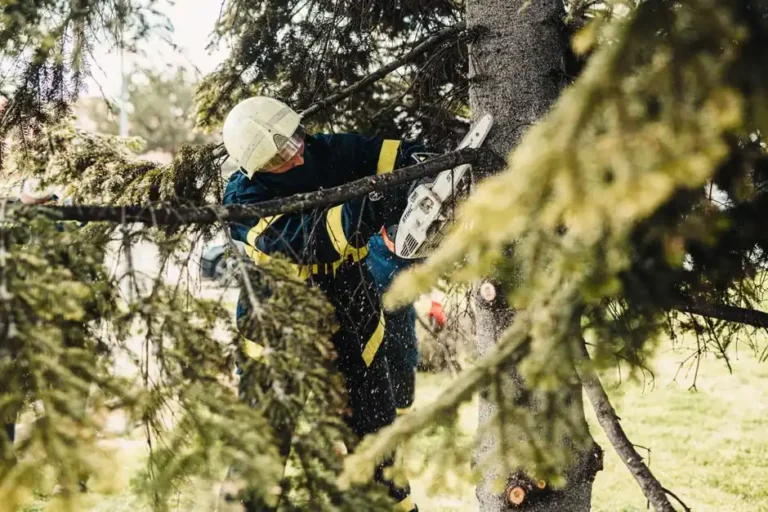
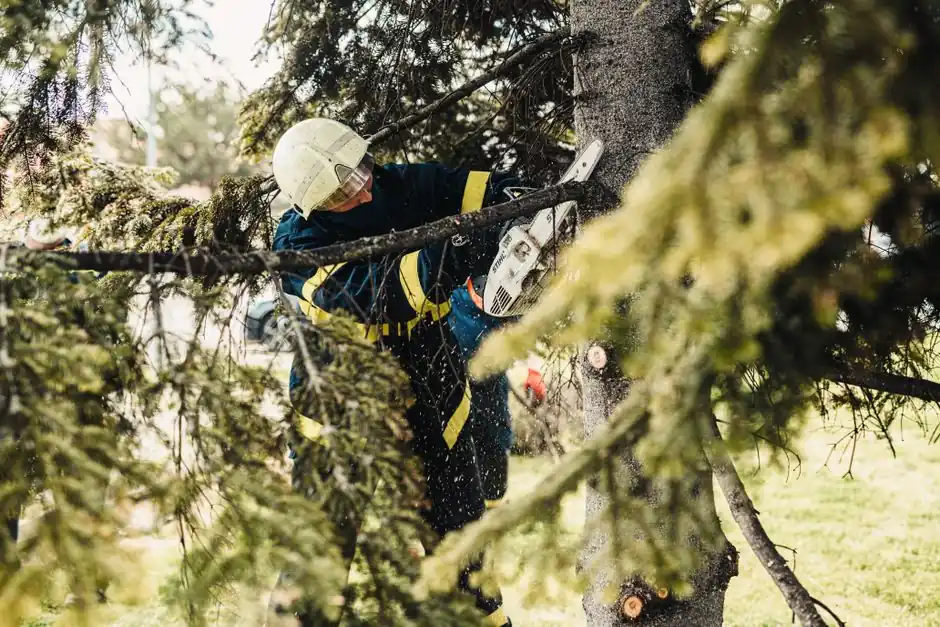
As a plain threshold: if a cut requires a ladder, a pole saw fully extended overhead, or a chainsaw used anywhere above shoulder height, it is professional work. Most serious homeowner tree injuries happen exactly there — ladders, overhead cuts, and spring-loaded limbs.
Post-storm canopies hide hanging limbs and cracked forks that only show themselves in the next wind. If a storm dropped limbs elsewhere in your yard, the trees still standing over your house deserve an inspection, not an assumption.
When the tree matters — shade over the house, a specimen you planted decades ago — the decision deserves diagnosis before action. Soil, roots, disease, and structure all feed into it, and the right answer is sometimes the less drastic one. Before you book anyone, it also pays to know the questions to ask before hiring a tree service in Evansville so you can judge the answers you get.
What is the difference between an arborist and a tree service? The words overlap in everyday use. “Arborist” properly describes a tree-care professional trained in tree health, diagnosis, and safe work practices; a tree service is the company that performs the work — removals, pruning, stump work. Some companies employ arborists, some focus on removal work. What matters for you is whether the person assessing your tree can diagnose health and structure, not just cut wood.
How quickly should I act on a cracked or leaning tree? Treat sudden changes as urgent. A new lean with lifted soil or a fork that is actively separating can fail in the next storm — or on a calm day, since failing roots do not need wind. Keep people and vehicles out of the fall zone, and get the tree assessed as soon as you can arrange it. Cosmetic issues can wait weeks; structural changes should not wait for a convenient season.
Can I prune a tree that is touching power lines if I am careful? No. Contact with an energized line can carry current through the tree, the tool, and you, and lines that look insulated often are not in the way homeowners assume. Trees in lines are handled with the utility’s involvement and by crews trained and equipped for that work. If branches are merely close to a service drop to your house, a professional can tell you where your responsibility ends and the utility’s begins.
Is it worth paying for an assessment if the tree might just need removal? Yes, because the assessment is what makes the removal decision sound — or prevents an unnecessary one. Trees are regularly condemned by guesswork when their real problem was roots, soil, or a reversible stress, and other trees are trusted for years while decay hollows them. On a large tree over a house, a professional diagnosis is the most valuable information in the whole process.
What should I expect during a professional tree assessment? Expect a walk around the tree covering canopy condition, trunk and root flare, visible decay or insect signs, site conditions like soil and drainage, and what stands within falling distance. You should come away with a plain explanation of what is wrong, the realistic options — monitor, prune, treat, or remove — and why. An assessment that jumps straight to removal without examining the tree is a sales pitch, not a diagnosis.
If your tree matches anything on this list, the next step is a professional set of eyes on it — before weather or gravity makes the decision for you. Call (844) 542-2293 to request service, and a tree professional can assess the situation and explain your options clearly.