

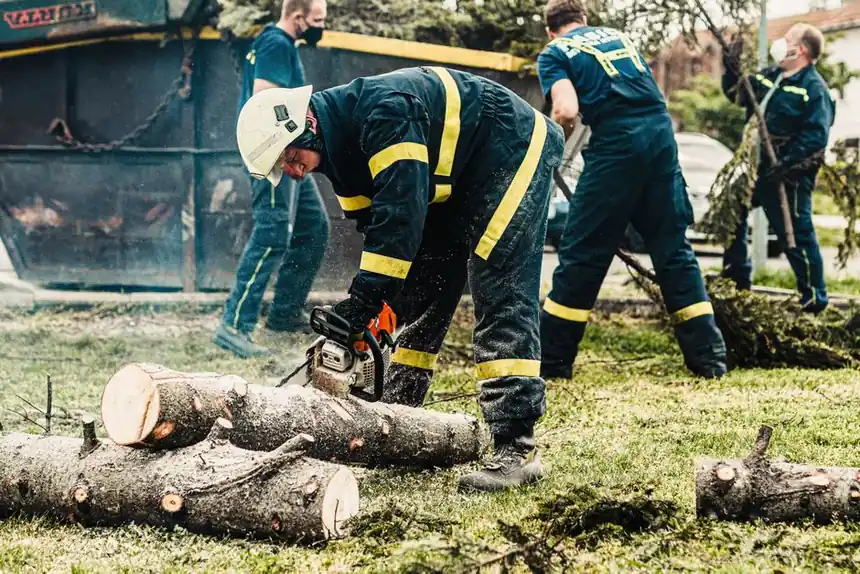
To compare tree service estimates fairly, first make sure every company priced the same job: the same trees, the same work on each tree, the same cleanup, and the same stump handling. Most confusion between quotes is not about money at all. It is about scope. One estimate quietly includes hauling and grinding while another leaves logs, brush, and the stump behind, so the totals describe two different projects.
Once the scope matches, the comparison becomes honest. This guide shows you how to line estimates up side by side, what each section should tell you, and which red flags matter more than any number on the page.
Write down, in plain language, what you want done. For example: remove the silver maple in the back corner, grind the stump, haul all wood and brush, leave the yard raked. Give that same description to every company. If one estimator recommends different work, such as pruning instead of removal, note it as a different proposal rather than a competing price for the same job.
If you have not yet gathered your questions, start with the companion piece on questions to ask before hiring a tree service in Evansville, then use the estimates themselves to test the answers you received.

The estimate should name each tree and the operation planned for it: removal, trimming, pruning, or stump work. Watch for scope differences that hide inside similar wording. “Take down the oak” can mean felling it in sections with rigging over your roof, or dropping it whole into a clearing. Both are removal, but they are not the same job, the same risk, or the same crew size.
Check each document for the finishing work that decides how your yard looks on day two:
An estimate that omits these lines has not forgotten them. It has excluded them, and you may be quoted again for each one later. Our breakdown of what affects the cost of tree removal in Evansville explains which of these factors move a total and why, without any two jobs being truly alike.
Serious estimates reflect a method: climbers or a lift, rigging for pieces over structures, a chipper sized for the brush volume. When one proposal describes controlled lowering of sections and another says nothing about method, that silence is a scope difference too. Work over a roof, deck, or line should never be the vague line in the comparison.
Every estimate you seriously consider should come with proof of insurance you can verify, the same standard described in our tree services overview. If one company provides a certificate and another waves the question off, the comparison is already decided on risk, whatever the totals say. Keep the paperwork with the estimate so the whole agreement lives in one place.
After Evansville storms, crews with no local base sometimes go street by street offering immediate work. Some are legitimate travelers; many are not reachable a week later. Warning signs include no written estimate, no insurance certificate, a vehicle with no company identification, and pressure to decide before they “leave the neighborhood.” Storm pressure is exactly when paperwork matters most.
A total with no breakdown gives you nothing to compare and nothing to hold the company to. If cleanup, the stump, or hauling is not mentioned, assume it is not included, and ask for the document to be rewritten with the full scope before you judge it against detailed estimates.
Vague scope invites change orders. Ask each company how unexpected findings, such as hidden decay, are handled. The professional answer is that work stops, the finding is shown to you, and nothing extra proceeds without your approval. If that answer is missing, the lowest starting total may not stay the lowest.
Requiring complete payment before work begins, or refusing normal payment methods, shifts every risk onto you. Payment on completion of the written scope is the standard arrangement to look for.
Because they are often estimates for different amounts of work. One may include rigging a tree down in sections, grinding the stump, hauling everything, and raking the site, while another covers cutting the tree and leaving the rest. Crew size, equipment, insurance, and disposal all sit inside a total. Until the written scopes match line by line, the gap between totals tells you almost nothing about which company is the better choice.
No. The middle number is not a quality signal. Choose the estimate whose scope is complete, whose method fits your property, and whose paperwork checks out. Sometimes that is the highest total, because it was the only one that included everything. Sometimes a leaner estimate wins because the company genuinely runs a smaller, efficient crew. The document, not its position in the stack, should make the decision for you.
Treat it as a different proposal, not a competing bid. A company that inspects and finds the tree structurally sound may honestly recommend pruning, which is a legitimate professional judgment. Ask what condition they found, what the pruning would involve, and how the tree should be monitored afterward. That conversation tells you more about a company’s standards than any line item, and it may save a healthy tree.
Two or three is the practical range for most residential jobs. Fewer than two leaves you with nothing to compare; more than three usually repeats the same information and delays work that may be time-sensitive, like a cracked or leaning tree. Make sure each one follows the same written scope you defined, and keep all the documents together so differences are easy to spot when you decide.
A careful comparison takes twenty minutes and the documents you already have. Match the scopes, read what is missing, check the paperwork, and let red flags outweigh arithmetic. When you are ready to request a written estimate for a clearly defined job on your Evansville property, call (844) 542-2293 and describe the trees involved, and ask for the full scope, cleanup and stump handling included, in writing.