A tree usually needs to be removed when it is dead, dying beyond recovery, structurally unsound, leaning toward a home or driveway, or damaging property with its roots or falling limbs. One warning sign alone rarely settles the question. In most Evansville yards, it is the combination that matters: a thinning canopy, cracks or fungus on the trunk, and a tree close enough to reach a roof, a car, or a sidewalk if it fails.
The walk-through below covers the signs that matter most, how to spot them from the ground, and when the problem is urgent rather than routine.
A healthy tree leafs out evenly in spring and holds a full canopy through summer. A tree on its way out often does the opposite. Large sections at the top or on one side stay bare while the rest of the tree leafs out. Leaves come in small, pale, or sparse. Branches die back from the tips inward, season after season, and the tree drops limbs in calm weather instead of only during storms.
Some decline is slow and easy to miss because it happens a little each year. Compare the tree with a healthy tree of the same kind nearby. If its canopy keeps thinning while the others stay full, the tree is telling you something. To work out whether it is already gone or still fighting, read our guide on how to tell a dead tree from a dying one before deciding what happens next.
The trunk is the tree’s main support, so damage here carries more weight than damage in the branches. Watch for long vertical cracks, seams where the bark has split, and areas where bark is peeling away to reveal soft, crumbly, or hollow-sounding wood underneath. Cavities matter most when they sit at the base of the trunk or where major limbs join it, because those are the points that carry the load in high wind.
Fungus is another serious signal. Mushrooms at the base of the trunk, shelf-like growths on the trunk, or a ring of mushrooms over the root zone usually mean decay is working inside the tree, even if the canopy still looks passable. Internal decay does not heal, which is why trunk and root problems often end in planned tree removal rather than in pruning.
A tree that grew into a lean gradually over years is different from a tree that has suddenly changed position. A new lean, especially after a storm or heavy rain in the Ohio River valley, points to root failure: the root plate is lifting on one side and the soil is cracking on the other. Saturated clay-heavy soil lets roots slip instead of holding, which is why so many Evansville trees go over after wet, windy nights.
Treat a fresh lean toward a house, garage, or play area as urgent, not as a wait-and-see problem. Keep people and pets away from the fall zone and arrange emergency tree service so the tree can be assessed before the next round of wind does the deciding.
Sometimes the tree is not dying at all. It is simply in the wrong place, and it has outgrown the space it was given. Surface roots can heave sidewalks and driveway edges. Roots under a shallow foundation or an older clay sewer line can add pressure and exploit cracks that are already there. Branches that overhang the roof drop debris into gutters, scuff shingles, and give squirrels and raccoons a bridge to the attic.
When a healthy tree causes damage year after year, and cutting it back would leave it lopsided or unstable, removal is often the honest answer. A badly unbalanced tree is a weaker tree, and weaker trees are the ones that fail in storms.
Walk around the tree slowly, look up, look down, and note what you find:
Two or more items on that list, on a tree that can reach something valuable, is a reasonable trigger for a professional assessment.
Not every problem tree has to come down. A tree with a few dead branches in an otherwise full canopy usually needs those branches pruned out, not a removal. A young tree struggling after a dry summer may need watering and mulch more than anything. Insect damage and some diseases, caught before they reach the trunk, can be managed. The point of assessment is to separate trees that can recover with care from trees whose structure is already compromised.
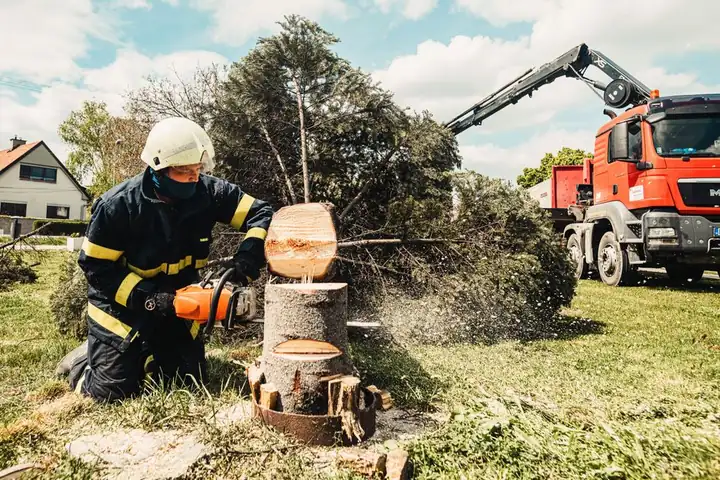
A tree is usually too far gone when dead canopy, trunk decay, and root problems show up together. If large sections never leaf out, the trunk has cracks, cavities, or fungus at its base, and the tree stands within reach of a roof or driveway, recovery is unlikely. An on-site assessment can confirm how much sound wood is left and whether any part of the tree can realistically be kept safely.
A long-standing lean that a tree grew into gradually can often be monitored, especially when the roots and trunk are sound. A new or sudden lean is different, because it usually means the root plate has started to fail. That kind of movement rarely reverses itself, and the tree usually needs removal before it falls on its own schedule instead of yours.
Not always, because a tree can survive for years with a hollow center as long as the outer shell of wood is thick and strong enough to carry the canopy. The risk rises when the opening is wide, the remaining wall is thin, or the cavity sits at the base or at a major limb union. Only an in-person inspection, sometimes with sounding tools, can judge how much strength is left.
Sometimes, yes, when the tree has outgrown its space and the alternatives cause more harm. If roots keep lifting concrete, branches rest on the roof, and heavy cutting would leave the tree badly unbalanced, removal protects both the house and avoids leaving you with a weakened tree. When there is room to reduce the canopy safely and keep the tree balanced, that is usually tried first.
If your tree matches two or more signs on the checklist, have it looked at before the next storm tests it for you. We will tell you plainly whether it needs removal, whether care can save it, or whether it simply needs watching. Call (844) 542-2293 to request an assessment and talk through what you are seeing in your yard.