
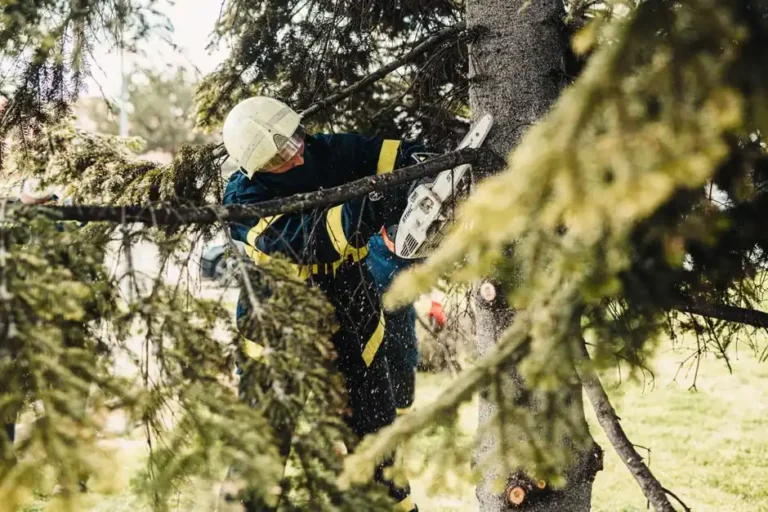
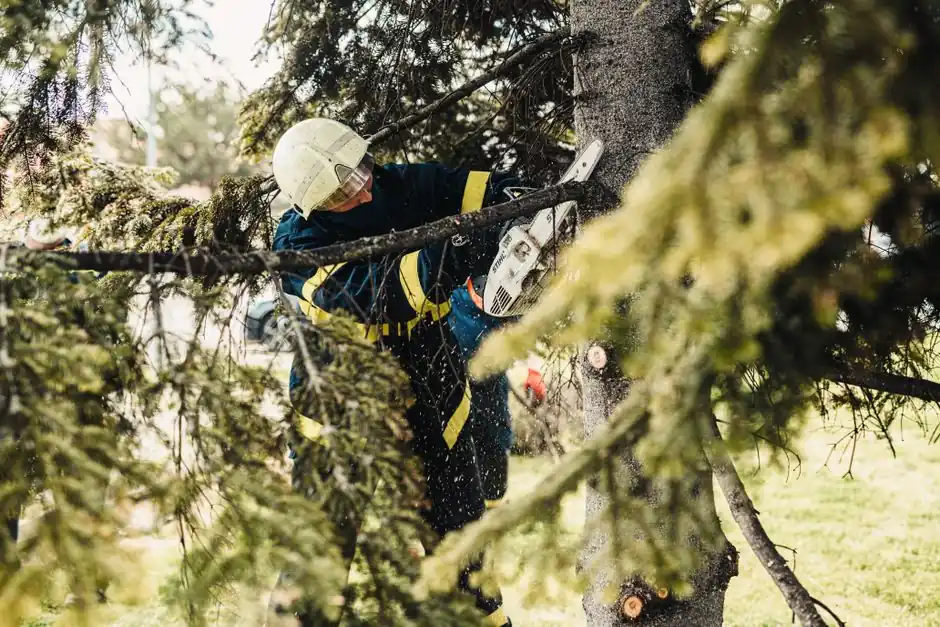
When an ice storm moves through Evansville, the damage is usually done quietly overnight. Ice builds on every twig and branch, and a mature tree can end up carrying thousands of extra pounds it was never built to hold. Some trees bend and recover. Others split, shed major limbs, or lose their crowns entirely. Knowing which is which — and what to do in the first days after the storm — decides whether a damaged tree survives or becomes a hazard.
Evansville sits in a part of the Ohio River Valley where freezing rain is a regular winter threat, not a rare event. A quarter inch of ice is hard on trees; a half inch can snap limbs that looked perfectly healthy the day before.
Ice does not damage trees evenly. It exploits whatever weakness is already there.
A thin glaze looks harmless, but ice coats every surface it touches. The branch surface area on a large shade tree is enormous, so a quarter inch of ice can add hundreds of pounds to a medium tree, and a half inch can add thousands. Wind turns that static weight into a lever, which is why many limbs fail hours after the rain stops.
The limbs that break are rarely random. Codominant stems — two trunks of similar size growing from one tight, V-shaped fork — are the classic ice failure, because bark trapped inside the fork means the stems were never strongly joined. Old topping cuts, decay pockets, and long limbs weighted at the tips also fail early.
Bradford and other callery pears are notorious in Indiana winters: their upright, crowded branching and weak forks split apart under ice loads that oaks shrug off. Silver maple, willow, Siberian elm, and hackberry are also relatively brittle. Bur oak, Kentucky coffeetree, and most hickories hold up better, though no species is immune when ice is heavy enough.
Wait until ice has melted and branches have stopped falling — the ground under a damaged canopy is the most dangerous place in your yard. If a tree or limb is touching a power line, stay away entirely and call the utility; that belongs to line-clearance crews, while emergency tree service in Evansville handles hazards on the house, driveway, or roof.
Walk the yard from a distance and note:
Take photos for your records before anything is cut. Then sort what you see into the two categories below.
Many ice-damaged trees recover well with corrective tree pruning in Evansville once the wood has thawed:
The key rule: never leave a stub at a jagged break. Stubs die back, invite decay, and sprout weak regrowth. Every cut belongs at a proper junction.
Be honest about the other category. A tree is unlikely to recover — and may become a standing liability — when:
A tree professional can assess borderline cases in person, because internal cracks are not always visible from the ground. For trees in this second group, planned removal on a calm day is far safer than waiting for the next storm to finish the job.
Most ice failure is decided years earlier, by structure. Structural pruning on young trees — one central leader, well-spaced scaffold branches, no tight forks — is the single best prevention. Our winter tree care tips for Evansville cover the seasonal routine in detail. In short: prune for structure in late winter, remove deadwood before storm season, and never top a tree to “reduce its weight” — topping produces exactly the weak, crowded regrowth ice tears apart first.
How much ice does it take to damage a tree? Damage can begin with as little as a quarter inch of ice on branches, especially on brittle species like Bradford pear and silver maple. At a half inch, the added weight on a large canopy can reach thousands of pounds, and widespread limb failure is common. The condition of the tree matters as much as the measurement: a well-structured oak may survive a storm that splits a neglected pear in half.
Should I knock ice off my trees with a pole or broom? No. Frozen branches are brittle, and striking them usually breaks wood that would have survived, while putting you directly under loaded limbs that can fall without warning. Shaking or hitting an ice-coated tree is one of the most common ways homeowners get hurt after winter storms. Let the ice melt on its own; if a limb is hanging over a walkway or roof, keep people away and have it removed professionally.
Can a tree that lost a big limb survive? Often, yes. If the limb tore away without ripping deep into the trunk, the remaining crown is intact, and the break is cleaned up with a proper cut at the branch collar, many trees seal the wound and keep growing for decades. Survival odds drop when the tear strips bark down the trunk, when the fork itself split, or when the tree lost most of its crown in the same storm.
When should ice damage be pruned? Safety hazards — hanging limbs, splits over roofs and driveways — should be handled as soon as conditions allow. Cosmetic corrective pruning is best done after the wood has fully thawed and you can see which buds and branches are actually alive, often late winter. Cutting too eagerly in the first days can remove branches that would have leafed out in spring.
Does ice damage make a tree more likely to fail later? It can. Splits and torn bark create entry points for decay, and regrowth sprouting from storm breaks attaches weakly compared with original branches. A damaged tree should be re-checked each year for cracks opening further, fungus growth at old wounds, and dieback spreading from broken ends. Catching that decline early gives you the choice of corrective pruning or planned removal, instead of another emergency.
If your Evansville yard took ice damage and you are not sure which trees can be saved, a ground-level look is not always enough to judge cracks and splits. Call (844) 542-2293 to request service, and a tree professional can assess which trees need corrective pruning, which need monitoring, and which should come down before the next storm tests them again.