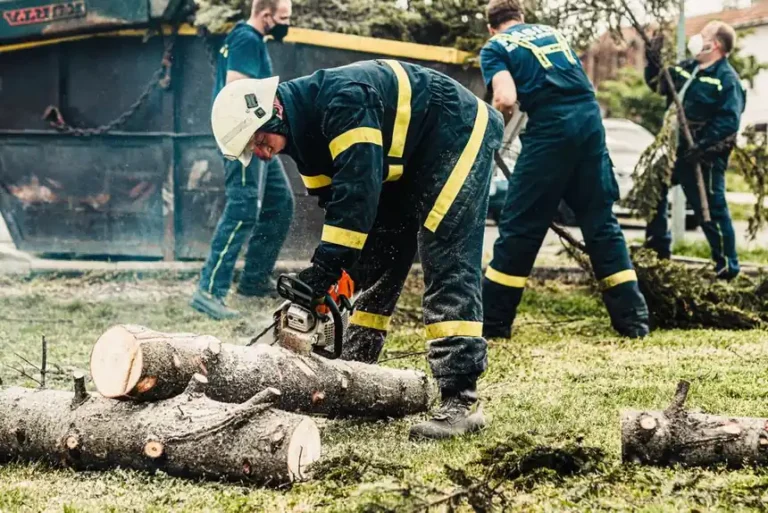
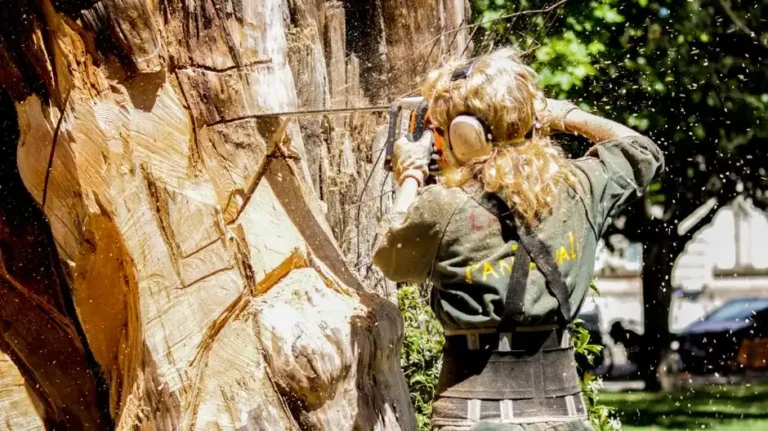
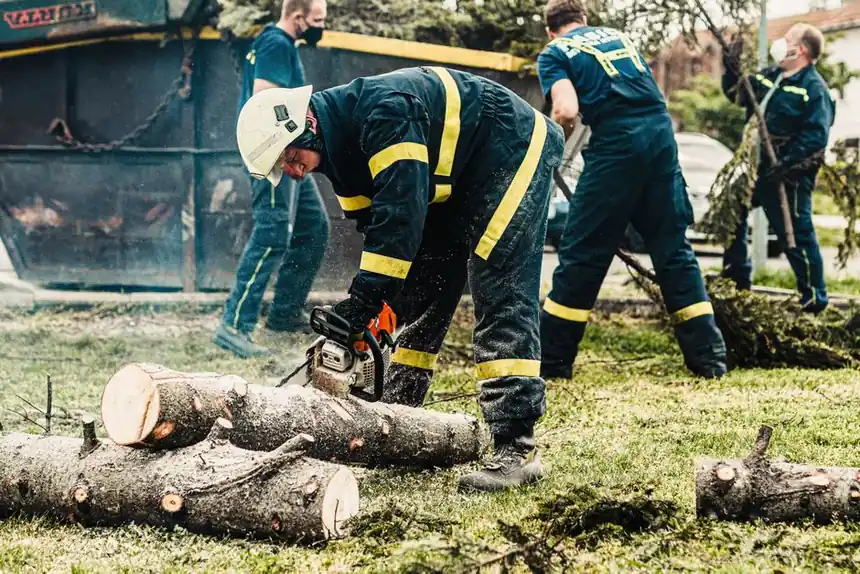
To prepare your trees for storm season, remove deadwood, correct weak branch unions, reduce end weight on long overextended limbs, and check the root zone for decay or lifting soil, all before severe weather arrives. Most trees that fail in Evansville storms had a visible weakness beforehand. Preparation means finding those weaknesses on a calm day, when fixing them is routine work instead of emergency work.
Southern Indiana weather delivers the full range: spring windstorms on saturated ground, summer thunderstorms, tornado risk, and winter ice. Each loads a tree differently, but the same structural flaws show up in the failures again and again.
Dead branches have no flexibility and no strong attachment. In wind they snap and fall; under ice they break under their own added weight. Deadwood is also the easiest weakness to fix, because removing it is safe in almost any season and immediately reduces what can fall on roofs, cars, and sidewalks.
Branches that meet the trunk, or each other, at a narrow V-shape often trap bark inside the union as they grow. That bark-included union never develops the wood-to-wood strength of a wide, healthy attachment, and it is where trunks split in high wind. Codominant stems, two trunks of similar size rising from one point, are the classic Evansville storm failure: the crown looks full and healthy while the connection at its base is quietly weak.
Branches that reach far over roofs or streets carry their weight at the end of a long lever. Wind works on that leverage, and ice multiplies the load. Reducing end weight, done correctly by a professional who cuts back to suitable lateral branches, lowers the force without gutting the tree’s canopy.
A tree is only as storm-ready as its anchor. Fungal growth at the base, cracked or lifting soil on one side, a trunk cavity, or roots severed by past trenching and construction all compromise stability. These trees may not drop a branch in a storm; they may come over whole, roots and all, especially when wind follows heavy rain on soft Ohio River valley soil.
Start at the crown and work down: deadwood, cracked limbs, weak unions, then trunk defects, then the root flare and soil. Our after-storm tree damage checklist for Evansville works just as well before a storm, because the warning signs are the same ones that matter afterward.
Preparation pruning removes deadwood, corrects crossing and weakly attached branches, and reduces end weight where leverage is dangerous. It does not mean topping the tree or stripping interior branches, both of which make trees more dangerous over time by forcing weak regrowth. The goal is a structure that sheds wind and carries ice with balanced weight.
For a valuable tree with a weak union that pruning alone cannot correct, a professional may recommend a support system: cables high in the crown, sometimes combined with bracing rods through the union. Installed and inspected correctly, these systems share the load between stems and can extend the safe life of a tree that would otherwise be a removal candidate. They are an engineering decision, not a routine add-on, and they need periodic inspection to remain trustworthy.
Some trees should not be prepared; they should be removed before the storm chooses the timing. Advanced trunk decay, a worsening lean with lifting soil, or a large dead tree over a house are removal conversations. A planned emergency tree service in Evansville call after a failure costs you control of when, how, and onto what the tree comes down. Planned removal keeps all three in your hands.
Preparation is not only about the tree itself. Note what stands within falling distance: roofs, fences, play equipment, parked cars, and lines. Keep the area under suspect limbs clear during severe weather. Photograph your mature trees each year so gradual leans or growing cracks can be compared over time rather than guessed at. And know the difference between tree work you can schedule and damage you should never approach, a branch on a line or a trunk resting on a roof belongs to professionals and the utility, as our page on storm damage cleanup explains in sequence.
Ideally, the dormant season before spring storms is when structural work is easiest and most effective, but preparation has no wrong month. Deadwood and obvious hazards should be handled whenever they are found, in any season. Think of it as an annual cycle rather than a deadline: inspect in late winter, correct what you find, and re-check after every major storm so new damage never gets a full year to worsen.
Done correctly, selective thinning can reduce wind resistance and remove the branches most likely to fail. Done badly, it does the opposite. Stripping interior growth leaves all the weight at the branch ends, where leverage is worst, and forces weak regrowth. The difference is technique: a professional thins by choosing specific branches for structure and balance, never by hollowing the tree out. Ask what will be removed and why before approving any thinning work.
It depends on why it leans. A long-standing lean with a curved, corrected trunk and no soil movement is often stable and simply monitored. A new lean, or one with cracked, lifted soil at the base and a trunk that used to stand straight, signals root failure and is dangerous. That distinction is exactly what an on-site inspection is for; photographs and guesswork from the ground cannot settle it safely.
Keep people and pets away from damaged trees, hanging branches, and anything touching a line, and treat every downed line as energized. Photograph damage from a safe distance for your records. Then call for an assessment of hazards first, cleanup second. Making the property safe is the priority job; grinding, hauling, and restoration happen after nothing overhead can still fall.
Every Evansville storm reads the same short list of flaws: deadwood, weak unions, heavy ends, tired roots. A calm-day inspection finds them first. If your property has mature trees you have never had assessed, call (844) 542-2293 to arrange a storm-readiness inspection and correct what can be corrected while it is still routine work.