
After a storm, check your trees from the ground before you check anything else up close. Walk the yard looking up and out, not under damaged limbs, and note broken hanging branches, new leans, cracked trunks, and lifted soil around roots. Photograph everything for your records, keep people away from anything hung up in the canopy, and sort the damage into emergencies, soon, and can-wait. Most post-storm injuries to homeowners happen during this inspection and cleanup stage, not during the storm itself.
Before you assess a single branch, rule out the hazards that change everything. If any line is down or a tree is touching one, stop and treat the scene the way our guide to a tree on a power line describes: stay back and call the utility. In practical terms, your first pass is done from the sidewalk, the driveway, and the open middle of the yard, with your eyes moving from the ground to the canopy and back.
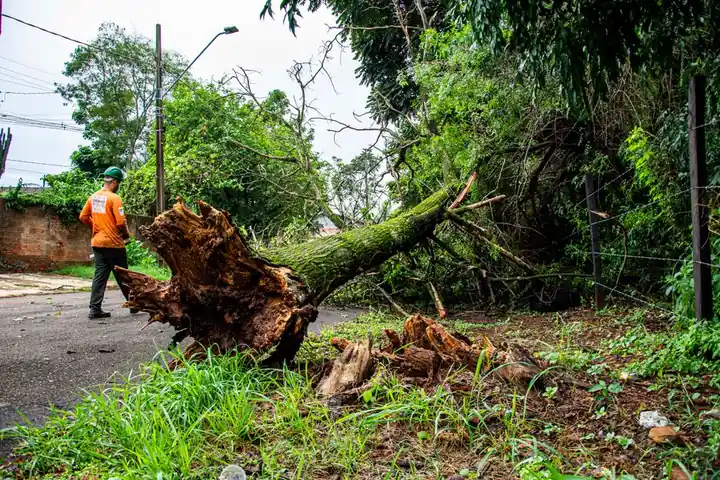
The obvious damage announces itself: a tree down, a limb across the fence. The expensive damage often hides. Evansville’s storm pattern, hard wind on saturated Ohio River valley soil, plus ice loading in winter, produces a particular set of problems worth hunting for deliberately.
Broken branches caught in the canopy are called hangers, and they fall later, often on calm days when nobody expects it. Scan each large tree slowly from several angles, looking for dangling or resting limbs that do not match the tree’s natural outline. Mark those trees as no-go zones underneath until they are cleared.
Check trunks for fresh vertical cracks and split crotches where two stems divide; storm twisting opens seams that are easy to miss at a glance. Compare each tree’s line to your memory and your photos: a lean that is new, or soil that has heaved and cracked on one side of the trunk, points to root movement. Root-lifted trees are unstable even when the canopy looks intact, and they belong on the professional list, not the watch list.
Torn bark, snapped leaders, and large limbs ripped away leave wounds that invite decay and insects through the coming seasons. Clean-up decisions in the first week shape how well a damaged tree recovers over the next five years, which is why preparation matters as much as reaction. Our guide to preparing your trees for storm season covers the pruning and inspection habits that reduce next season’s damage list.
Emergency now: trees on houses, lines, driveways, or sidewalks; hangers over roofs, entries, and play areas; root-lifted trees leaning toward targets. These go straight to our emergency tree service in Evansville.
Book soon: split trunks, cracked unions, large broken limbs still attached, and trees that lost a major portion of canopy over a target. They are stable today and unstable in the next wind.
Monitor: small broken twigs, minor bark scrapes away from the trunk’s main structure, and debris in open lawn. Photograph them, then look again after the next hard rain.
For the full cleanup that follows sorting, including debris hauling and stump decisions, see how our storm damage cleanup service handles the project stage once hazards are cleared.
Take more photos than feels necessary, from the same angles a day or a week later if work is staged. Keep the weather details: date, approximate time the storm passed, and what fell when, as far as you know it. Save every invoice and note every phone call. If a damaged tree later declines and becomes a second claim or a dispute with a neighbor, this file is the difference between a story and evidence. No article can tell you what your own policy covers, so pair good documentation with an early call to your insurer.
Inspect as soon as it is safe to be outside, ideally within hours of the storm passing, while the damage is fresh and before you move debris. Start from a distance, rule out downed lines and structural damage, and only then walk the yard. Some damage, like hangers settling lower or cracks opening further, shows itself over the following days, so a second, shorter walk-through later in the week is worthwhile.
A hanger is a broken branch that did not fall, but is caught in the canopy above. It is dangerous because its timing is unpredictable: wind, thaw, or nothing obvious at all can bring it down days after the storm, and it falls fast and heavy. Treat the ground under a hanger as off-limits for people, pets, and parked cars until a crew brings it down in a controlled way.
You can safely handle small debris that is already on the ground in open areas, well away from damaged trees. Drag branches rather than carrying loads over your head, and stop if anything requires pulling, climbing, or cutting wood that is bent, hung up, or under tension. The moment a job involves a ladder, a roof, or a saw on a loaded limb, it stops being yard work and becomes tree work.
A slight new lean deserves real attention, because it often comes with root movement you can confirm by checking for lifted or cracked soil on one side. Some trees stabilize; others continue to move with each rain on saturated ground. Photograph the lean, measure it against a fixed reference like a fence post in your photos, and have any lean toward a house, street, or play area assessed promptly.
Work through the list, then call (844) 542-2293 with what you found. We will help you sort the urgent from the patient, and our tree services overview shows everything else we handle across Evansville.